
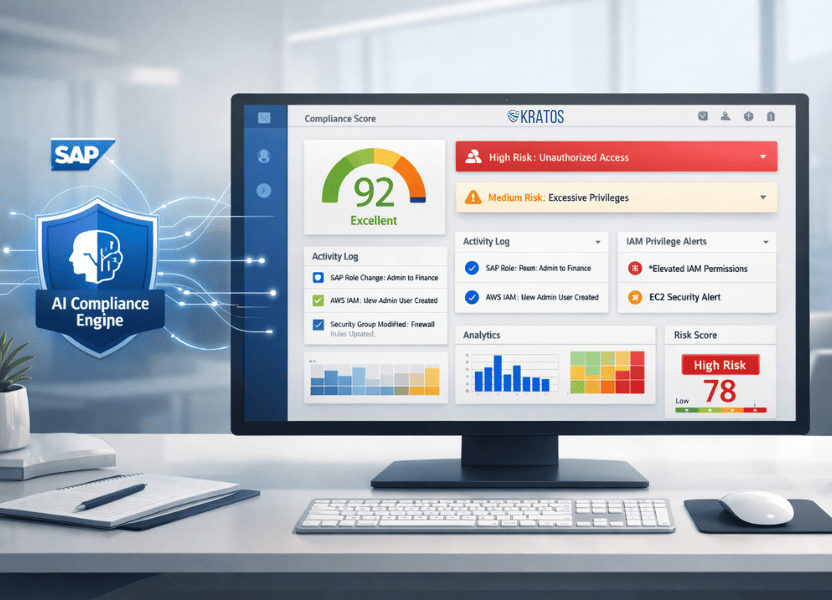
Introduction
Enterprise environments today are no longer confined to a single system. Organizations operate across SAP landscapes, AWS cloud infrastructure, and observability platforms like Datadog.
While this improves agility and scalability, it introduces a serious challenge:
Compliance blind spots. Traditional quarterly audits are no longer sufficient. Real-time monitoring has become essential.
The Risk of Periodic Compliance
Most organizations still rely on:
- Manual log reviews
- Quarterly access audits
- Spreadsheet-based reconciliations
- Reactive incident investigation
By the time a risk is detected, the damage may already be done.
Common risks include:
- Unauthorized SAP role changes
- AWS privilege escalations
- Security group misconfigurations
- Untracked financial document edits
- Hidden segregation-of-duties violations
In a multi-system architecture, these risks multiply.
Why Real-Time Monitoring Changes Everything
Real-time compliance allows organizations to:
- Detect access changes immediately
- Flag high-risk AWS activity instantly
- Correlate SAP user changes with infrastructure events
- Generate automated alerts
- Produce audit-ready documentation automatically
Instead of waiting for an audit, compliance becomes continuous.
The Role of AI in Modern Compliance
Manual rule-based systems struggle with:
- Volume of logs
- Cross-system reconciliation
- Identifying subtle anomalies
AI enhances compliance by:
- Detecting unusual patterns
- Assigning risk scores
- Learning behavioral baselines
- Reducing false positives
This transforms compliance from reactive oversight to proactive governance.
The Future: Compliance on Autopilot
Organizations that implement continuous compliance monitoring gain:
- Reduced audit preparation time
- Lower operational risk
- Improved governance visibility
- Faster incident response
- Stronger executive reporting
Real-time monitoring is no longer a competitive advantage. It is a necessity.